The brain guards itself fiercely. The blood-brain barrier, a physical wall of tightly sealed cells, has protected our neurons through millions of years of evolution, but that same protection now stands between patients and life-saving therapies for Alzheimer's, cancer, and chronic infection. My research group treats this barrier not as an obstacle to work around but as a structure to be understood and engineered. We build multiscale computational models that span Angstroms to microns, decoding the language of individual atoms into design principles for entire tissues. This computational lens has let us do what experiments alone could not. We have resolved the molecular architecture of the blood-brain barrier at nanoscale resolution and developed chemical strategies for tuning its permeability. In this talk, I will walk through the simulation framework that made this possible and share where this line of work is taking us next, toward engineering drug-delivery pathways through one of biology's oldest defenses. We call it barrier engineering, bridging angstroms to microns in the fight against Alzheimer's.
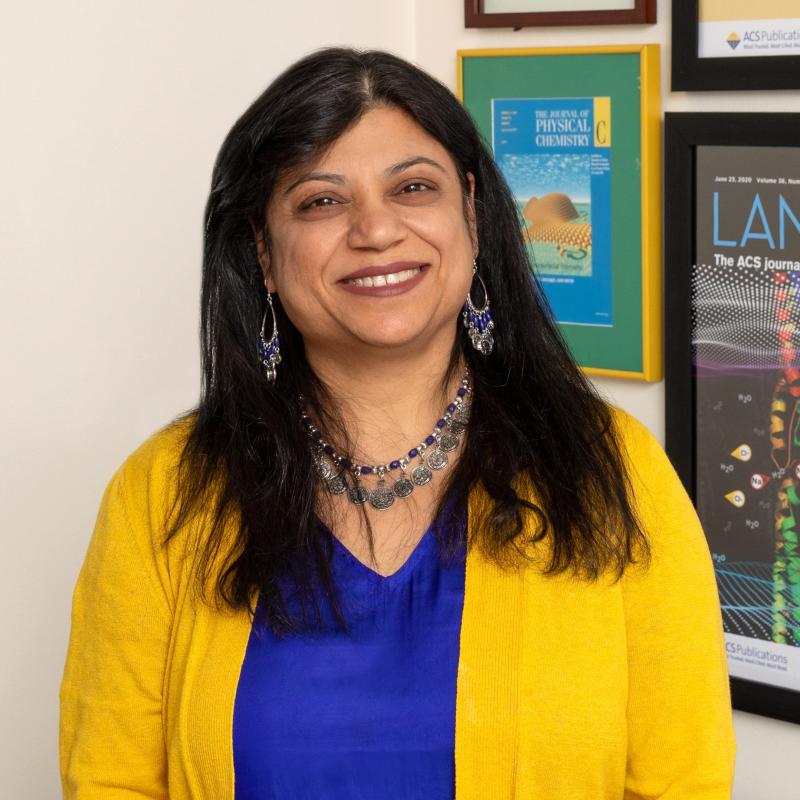
Shikha Nangia, PhD, is the Milton and Ann Stevenson Endowed Professor and Chair of the Biomedical and Chemical Engineering Department at Syracuse University, New York, USA. She is also the Laura J. and L. Douglas Meredith Professor for Teaching Excellence. Dr. Nangia received her PhD in Chemistry from the University of Minnesota, Twin Cities, USA, in 2006 and completed her postdoctoral training at Pennsylvania State University. She completed her MS in Chemistry from IIT Delhi in 2000. Dr. Nangia’s research uses computational approaches to overcome biological barriers and enhance drug delivery. Her research projects include exploring treatments for Alzheimer’s and Parkinson’s diseases, gut tight junctions, implantable device-related infections, and epigenetics. Her focus has been to examine the architecture of the blood-brain barrier to develop novel strategies to facilitate the transport of drug molecules into the brain. Dr Nangia’s research has received substantial funding from NSF, NIH, and other private foundations. Dr Nangia has also received numerous honors and awards for her research (NSF CAREER, Scialog Fellow, ACS OpenEye Faculty Award, ACS WCC Rising Star Award) and teaching throughout her career. She was recognized with the two Chancellor’s Awards: (i) for research excellence and (ii) outstanding contribution to the student experience at Syracuse University. She is an Associate Editor of ACS Applied Bio Materials.